The U.S. Labor Market Is Changing Fast—Here’s What It Really Means
The American job market isn’t just cooling off, it’s entering a new era. Old markers like “300,000 new jobs per month” are no longer true for economic health.
Why today’s labor slump is more than a blip?
Fewer New Jobs: and It’s Not Just Bad Data
In late 2023, the U.S. saw surprising labor numbers: a drop of about 100,000 jobs in October and only 60,000–65,000 added in November. That’s far from the expected 300,000.
Some dismiss this dip as a data issue, thanks to disruptions like government shutdowns. But there are signs that the slowdown reflects something deeper: an economy slowing with irreversible shifts.
Holiday Hiring Was a No-Show
Traditionally, retailers and logistics companies boost hiring around the holidays. Not this year. That usual surge just didn’t happen. Another warning sign. Employers may be cutting back, not because of weak demand, but because they’re cautiously eyeing new technologies like AI… even if those tools aren’t fully ready yet.
AI’s Reach Is Growing
Most people think of AI as a white-collar disruptor. But in 2023, we’re seeing hesitation to hire across industries. Including blue-collar work. Why? Companies are starting to calculate whether automation is worth it in roles once considered safe from tech replacement. And even if they aren’t using AI today, they might be planning for it tomorrow.
Demographics Mean a Smaller Workforce… Permanently
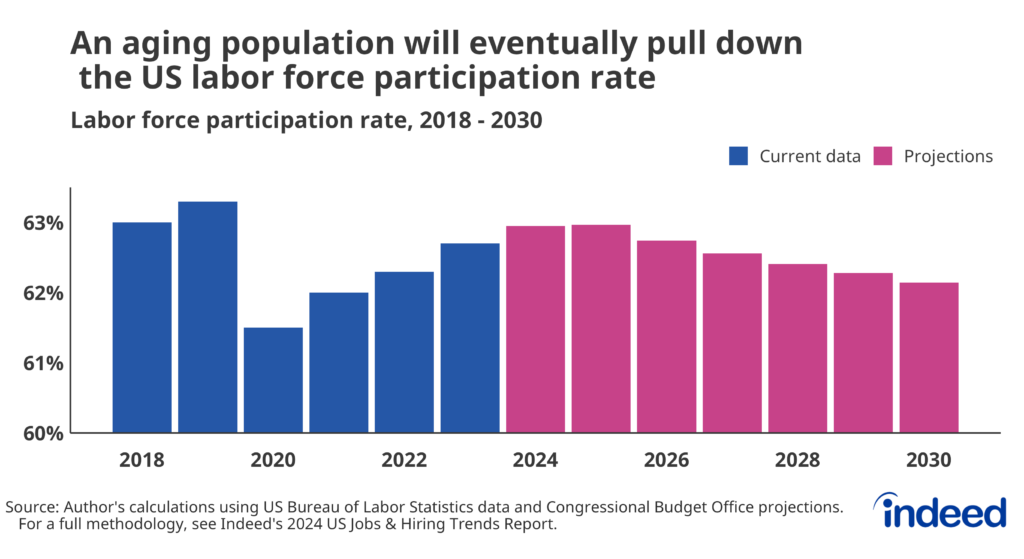
Here’s the game-changer: baby boomers, once 75 million strong, are retiring fast. About three-quarters are already gone from the workforce. Meanwhile, Gen Z (known as Zoomers) is the smallest generation yet. That’s a demographic math problem we can’t escape.
We’re shedding 500,000 to 750,000 workers annually, with more to come over the next decade. That means the baseline expectations for job growth must shift. The economy simply has fewer workers to power it.
Why U.S. Can’t Rely on Policy to Fill the Gaps
Yes, smart immigration could ease the labor crunch. But anti-immigration policies in recent years, including from the Trump era, have cut off a key source of new workers. And as baby boomers exit the workforce, they’re also pulling capital out of markets to fund their retirement, hence, drying up resources needed for innovation.
The result? Fewer workers, less investment, and weak policy support. Three ingredients for stubborn inflation.
Productivity: The Only Way Forward
With a shrinking labor pool and limited capital, improving productivity is the only realistic path to economic stability. That likely means more automation, more AI, and smarter systems.
But developing and scaling new tech takes money and time. We’re living through a transition period where gaps between capability, investment, and need to grow wider before they close.
Why U.S.-Mexico Collaboration Could Be a Game Changer
Given the long-term decline in the U.S. labor force and political resistance to traditional immigration solutions, there’s an emerging opportunity many businesses haven’t fully explored: strategic partnerships with Mexican companies.
Here’s why this matters:
- Demographics align in the opposite direction.- While the U.S. workforce is aging and shrinking, Mexico has a younger, growing labor force ready to step into global supply chains.
- Nearshoring.- With global supply chains shifting and the post-COVID “China+1” strategy taking hold, more U.S. companies are moving manufacturing and logistics closer to home. Mexico provides geographic proximity, cost-effective labor, and trade stability under the USMCA (the updated NAFTA).
- Shared productivity investments.- Mexican firms, especially in automation, manufacturing, and logistics, are rapidly adopting advanced technologies too. Collaborating with them can help U.S. companies scale productivity without bearing the entire capital burden alone.
- Bilateral benefits.- Instead of viewing labor and capital shortages as a purely domestic challenge, the U.S. could look to Mexico not simply for outsourcing, but for true co-development of talent, innovation, and infrastructure.
Bottom Line: If the U.S. lacks labor and capital internally, then cross-border collaboration, especially with a strategic partner like Mexico, could be the smartest path to maintaining productivity, curbing inflation, and future-proofing business.
The labor force is shrinking. Capital is tightening and yes, technology can help bridge the gap. But there is also a more immediate solution: Mexico
Just don’t wait for the old rules to come back, because they won’t.